
2. Architect of Governance and Administration
Home > Article Detail
Author: Shreyas Patil
Date: September 15, 2026
Introduction
Shivaji Maharaj was not only a military genius but also a revolutionary architect of governance. His administrative policies laid the foundation for a robust and sustainable state that balanced central authority with local autonomy. Unlike many rulers of his time, Shivaji focused on creating an efficient, inclusive, and people-centric administration, ensuring justice and prosperity for all his subjects.
This chapter explores Shivaji's administrative brilliance, focusing on his decentralized governance system, meritocratic policies, and innovations in taxation and justice.
________________________________________
The Ashta Pradhan Mandal: A Model of Decentralized Governance
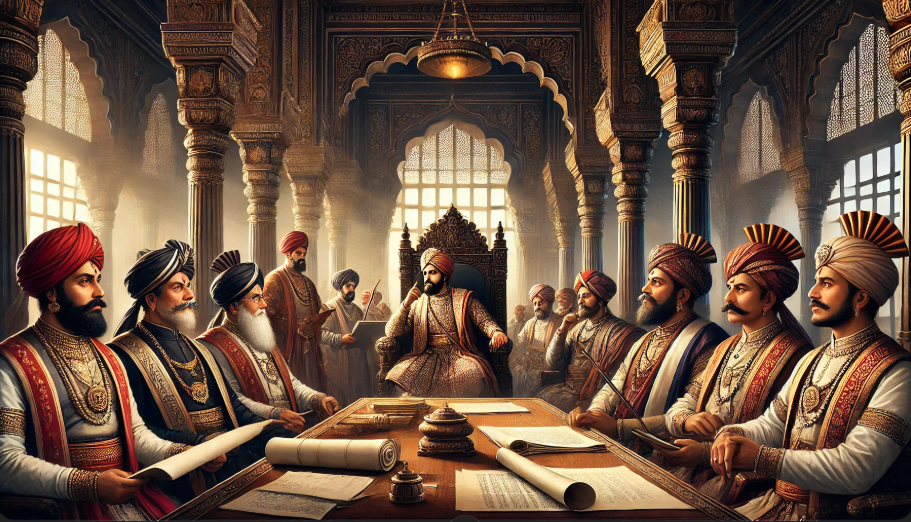
Shivaji’s Ashta Pradhan Mandal (Council of Eight Ministers) was a pioneering approach to administration. This council divided responsibilities among eight key officials, each with distinct roles, ensuring accountability and efficiency.
• Key Ministers and Their Roles:
1. Peshwa: Prime Minister, responsible for overall governance and policy-making.
2. Amatya: Finance Minister, overseeing state finances and revenue.
3. Sachiv: Secretary, handling correspondence and state documentation.
4. Mantri: Minister of Intelligence, maintaining records of daily activities.
5. Senapati: Commander-in-Chief, managing military strategies and operations.
6. Sumant: Foreign Minister, in charge of diplomacy and relations with other states.
7. Nyayadhish: Chief Justice, ensuring fairness in judicial processes.
8. Panditrao: High Priest, overseeing religious matters and social welfare.
This system ensured that Shivaji could delegate tasks effectively, allowing him to focus on strategic decision-making.
________________________________________
Meritocracy Over Heredity
Shivaji’s administration was notable for its emphasis on merit over birthright:
• He appointed officials based on their abilities, regardless of their caste or social background.
• This inclusivity fostered loyalty among his subjects and created a cadre of capable administrators and commanders.
________________________________________
Revenue and Taxation Reforms
Shivaji’s taxation system was innovative, efficient, and fair, aiming to reduce the burden on peasants while maximizing state revenue.
• Chauth and Sardeshmukhi:
o Chauth: A 25% tax levied on neighboring territories as protection money to avoid raids.
o Sardeshmukhi: An additional 10% tax collected from regions under Maratha influence.
• Land Revenue System:
o Taxes were calculated based on land productivity, ensuring fairness.
o Shivaji personally inspected the assessment process to prevent corruption.
• Direct Tax Collection:
o Shivaji eliminated middlemen, ensuring that farmers paid taxes directly to the state, increasing transparency.
________________________________________
Justice System
Shivaji prioritized fairness and justice, ensuring that his courts served the common people:
• Accessible Judiciary:
o Local disputes were resolved by village councils, while serious cases were escalated to state-level courts.
o Nyayadhish (Chief Justice) ensured that laws were applied uniformly.
• Protection of Rights:
o Shivaji strictly forbade the exploitation of women and marginalized communities.
o Harsh penalties were imposed for crimes like theft, assault, and corruption.
________________________________________
Military Administration
Shivaji’s military administration was tightly integrated with his governance:
• Division of Resources:
o He allocated a significant portion of state revenue to maintaining a strong army and navy.
• Logistics and Supplies:
o Forts were equipped with granaries and water reservoirs, ensuring readiness for prolonged sieges.
• Discipline and Code of Conduct:
o Soldiers were held to a strict ethical code, prohibiting harm to civilians and destruction of property during campaigns.
________________________________________
Inclusivity and Social Welfare
• Shivaji ensured that his policies benefited all sections of society:
o Encouraged participation from diverse communities, including Muslims, who held important administrative and military positions.
o Promoted the welfare of peasants and artisans by stabilizing markets and reducing exploitation.
________________________________________
Legacy of Shivaji’s Governance
Shivaji’s administrative policies set a benchmark for effective governance:
• His emphasis on decentralization inspired future Maratha rulers and influenced administrative practices during India’s struggle for independence.
• His model serves as a blueprint for modern governance systems focused on accountability, inclusivity, and fairness.
________________________________________
Key Takeaways
1. Shivaji’s governance emphasized decentralization, transparency, and inclusivity.
2. The Ashta Pradhan Mandal ensured efficient management of state affairs.
3. His policies protected the rights of peasants, artisans, and marginalized groups while promoting sustainable revenue generation.
________________________________________
Activity Corner
1. Case Study: Compare Shivaji’s decentralized governance system with modern-day federal systems.
2. Research Task: Analyze how Shivaji’s tax reforms balanced state revenue needs with the welfare of farmers.
3. Discussion Topic: How did Shivaji’s meritocratic policies contribute to the loyalty of his subjects?
________________________________________
Conclusion
This chapter provides an in-depth understanding of Shivaji Maharaj’s administrative brilliance, highlighting how his governance model was ahead of its time and continues to offer lessons for modern statecraft.